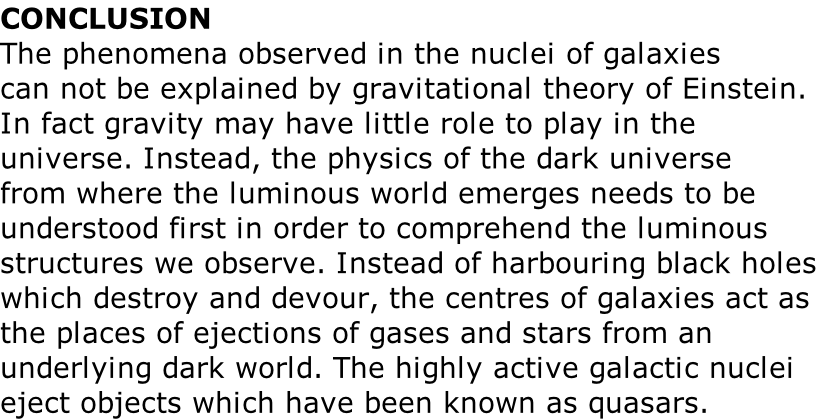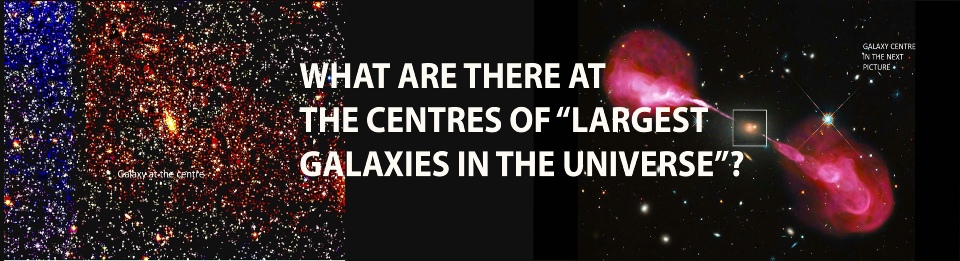

Questions of black holes of billions of solar masses devouring gases or black spirals ejecting material from the centre?

The galaxy situated at the centre of a cluster of galaxies known as Abel 2029 has been crowned as the largest galaxy in the universe. It is an ellptical galaxy showing high redshift in the spectra, which has received the named IC1101. Theoretical calculation using mainstream ideas of the origin of the redshift in cosmological expansion of the universe, indicates that its distance could be 4 billion light years from us. The calculated size of the semimajor axis of the galaxy is about 8 million light years, which is 80 times bigger than the size of our Milky Way galaxy. It is surrounded by a hallo of hot gasses emitting x-
Here I present an analysis based on the pictures I have found in the Internet which tells a different story about what may exist at the centre of this galaxy. There exists a dark spiral at the heart of the galaxy which is surrounded by a cluster of massive quasar like objects forming an elliptical shape around the centre. Ejections of smaller galaxies seem to be taking place from the centre of the Abell cluster. It is in contradiction to the theory of merging galaxies forming the cluster.
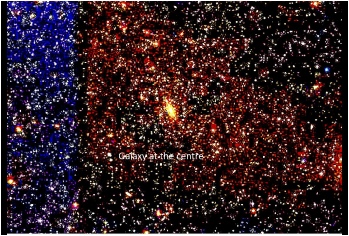
Abell cluster with IC1101 at its centre
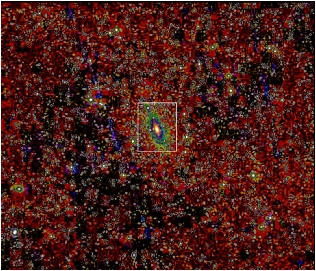
Massive galaxy cluster where galaxies lie along spiral arms like stars in a galaxy
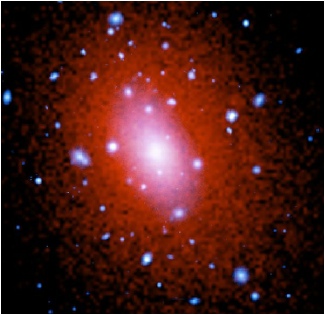
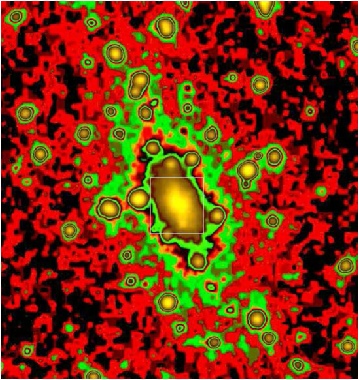
Hot central area of the cluster emitting x-
Ejections from the centre of the cluster
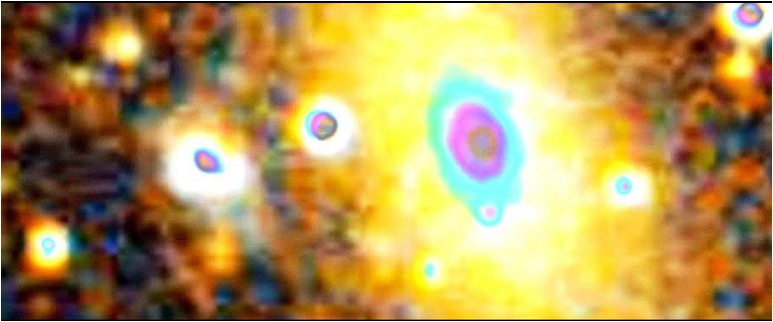
Huge elliptical ring at the heart of IC1101 which consists of clumpy structures.These clumps break away from the ring and ejected as galactic objects of high luminosities as seen in the picture.
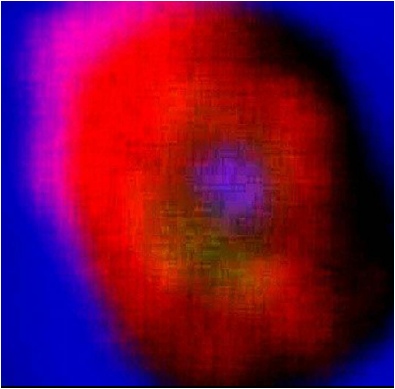
A black spot at the centre of IC1101

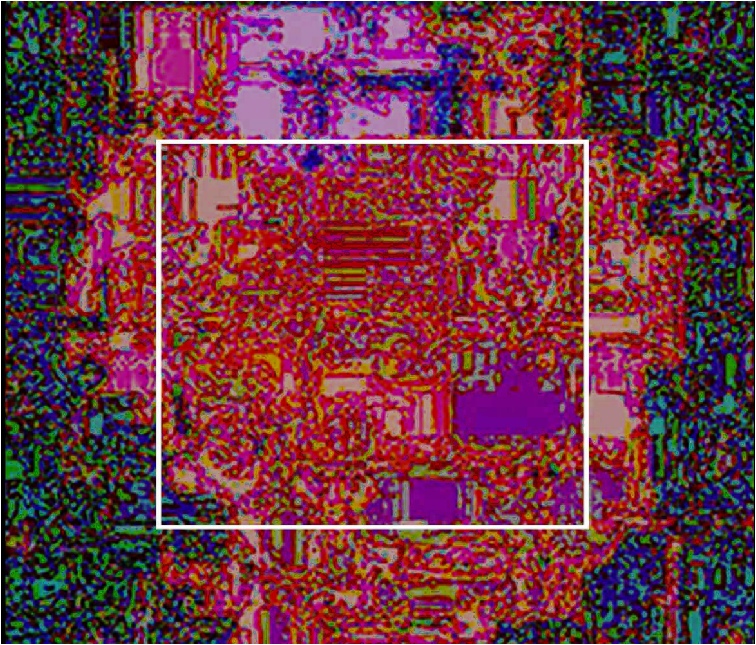
A dark spiral at the centre of IC1101
Instead of a black hole which destroys and devours, a dark spiral, which ejects and creates, is more generic feature of the centres of the galaxies in the universe. This dark spiral arises from a dark universe which underlies the existence of the luminous universe. The picture of ”black hole” taken at the centre of M87 also shows the existence of this dark spiral.

A radio galaxy (3C 348) in the constellation of Hercules named Hercules A has been described as the next largest galaxy in the universe. By interpreting its high redshift as due to cosmological expansion of the universe the mainstream researchers have concluded that this galaxy should exist about 2 billion light years away. Theoretical calculations show that at this distance the galaxy must be 1000 times more massive than the Milky Way and should contain the biggest black-
Many high redshift galaxies have close associations with nearby galaxies. So if one adopts a different interpretation of the redshift, (like plasma redshift), the galaxy will be very liitle impressive in feature than any other elliptical galaxies ejecting radio jets.
Here I present my studies which ejection of a massive quasar from the centre while the core seems to be split in half. The jets emerge from a dark realm at the middle of the separated halves.
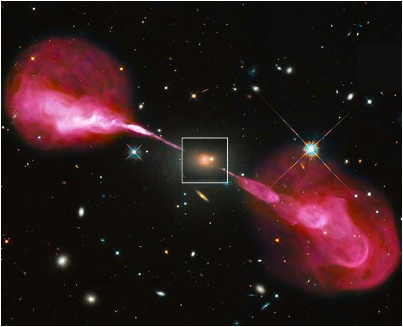
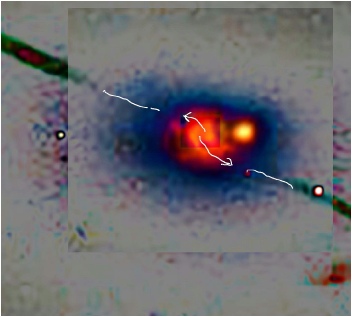

It is the central galaxy of the Virgo cluster, which is the nearest galaxy cluster to us. M87 is about 100 times more massive than our Milky Way galaxy. In 2019 first direct photograph of a black hole, which was 6.5 billion times the mass of the sun, was released. It was for the first time a black hole had been directly seen.
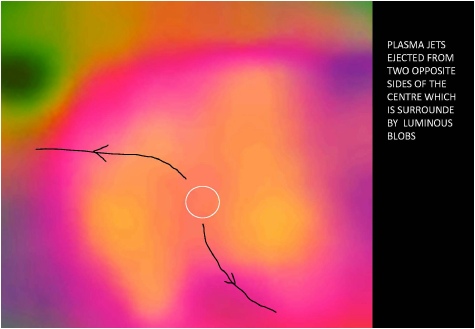
Here we show a dark spiral structure which exists inside the event horizon of the “black hole”.
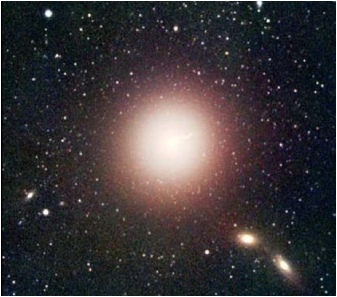
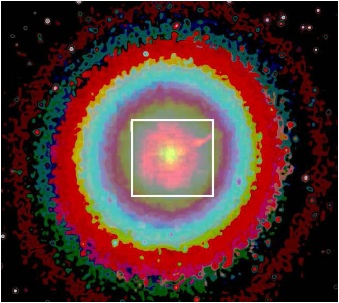
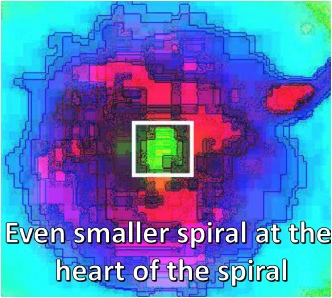
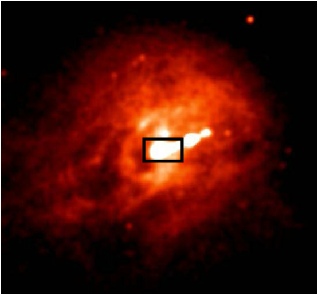
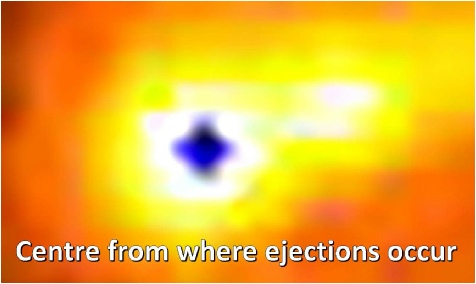
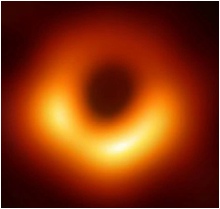


Zooming deeper and deeper inside the nucleus of M87 elliptical galaxy one arrives at the black spot surrounded by a luminous ring with variable luminosity around it.The last picture is a dark spiral which sits at he heart of the so called black hole from where no signal should ever come out. It is similar to what one sees in the nucleus of IC1101.