

There exist spiral structures inside the black spot surrounded by luminous rings which are interpreted as black-holes at the centres of galaxies

Until 50 years ago Black-hole was more a mathematical curiosity for those who shared the ideas of Einstein`s theory of gravity. After Hawking popularised black hole it had become a part of the main stream research in astrophysics.
It swallows material from its surrounding and draws them in a realm from where nothing can escape- not even light. Once materials fall beyond a boundary called “event horizon” they enter a spooky world whose nature would remain unknowable for ever. All information are lost. It has inspired many fiction writers and physicists who are interested in a weird world. Attempts to observe a black-hole progressed with the launching of X-ray satellites. When one observed strong x-ray emissions from the centre of the Milky way galaxy it created a lot of excitements. The emission was interpreted as caused by black-hole devouring stars from its surrounding. Later x-ray emissions were found to be coming from the winds of massive young stars harbouring at the centre.
After that excitement died down a bit, young stars orbiting a black hole at the centre of our galaxy was found around 15 years ago. Then came the discovery of a “doughnut” at the centre of M77 galaxy. It sparked the creation of theories that sych doughnut was created by the gases falling towards the super massive black-hole. It was argued that the matter drawn towards the black hole was forming an accretion disk, which was feeding the black-hole.The heated gas was seen as a luminous doughnut encircling a black spot which defined the boundary of the event horizon.
However, the first direct picture of the “black-hole” came in 2019 from the centre of the galaxy named M87 which was a massive elliptical galaxy sitting at the heart of Virgo cluster. The picture of the luminous ring encircling a dark spot went viral across the world: “It finally confirmed the existence of black-holes”. After this discovery came the news of the detection of gravitational waves. The observational data was interpreted as caused by merging of black-holes billions of light years away. Since then black-hole proponents are calculating black-hole masses through theoretical models which involved merging of these holes. By fitting gravitational wave data with predictions of the models they have started discovering black-holes which may be merging as far as 17 billion light years away.
I have been studying centres of galaxies since the x-ray observations started and come to realize that the “black holes” observed are altogether different species than what these theoreticians are trying to convince the world about. My studies show that the main activities at the centres of galaxies are ejections of massive stars, star clusters and quasar-looking objects. “Spiral wheels” help to accrete ejected material towards the centre. These “wheels” sit at the heart of all galaxies. Ejections mediated by the spiral, which is a fractal (which means smaller and smaller spirals lying in the womb of larger and larger ones), cause the formation of the luminous ring/torus around the region which appears dark (as in M87 centre). There exist “dark spiral” structures inside these dark spots. In active galaxies the rings break apart into quasar like objects which are then ejected from the centre. Thus, instead of matter falling inside a black hole, outflow of gases from a dark realm characterizes the activities at the centre. Many Seyfert galaxies show ejections of extremely luminous quasars.
I have studied centres of some nearby galaxies including Milky Way, as well as ejections from the centres of the Seyfert galaxies and the nuclei of central galaxies sitting at the heart of galaxy clusters (including M87 in Virgo).
Here I present a few examples of what I have found. My studies have convinced me that we truly live in a different universe than what is based on Einstein`s theory of gravity. You are welcome to visit this alternative universe without beginning and end in the link “Entangled Universe - Heaven Reborn”.
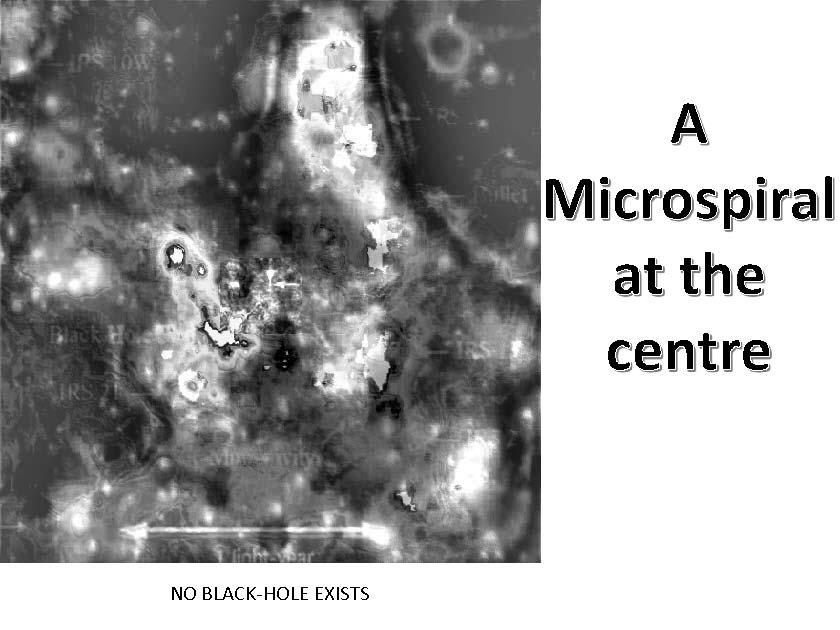

X-ray emissions from galactic centre. Whiter means stronger emission. SgrA*, where a black-hole is supposed to exist is marked by two white arrows inside a red ring drawn on the picture. A cluster of massive young stars known as IRS16 is seen being ejected from the centre which is about a light-month south of SgrA*. The object at the centre is a spiral which ejects and accretes.
FOR MORE SEE HERE….
M77 DOUGHNUT IN GALAXY CENTRE
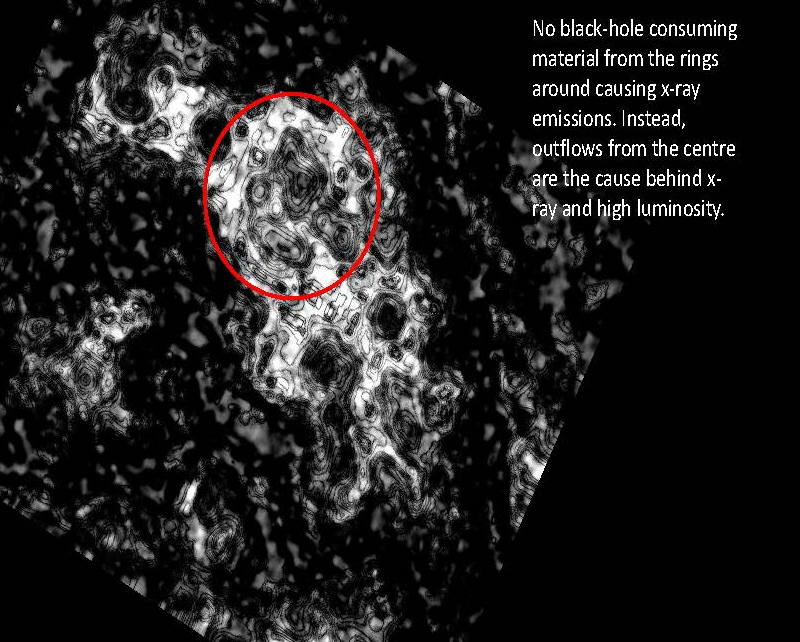
M77 is a type II Seyfert galaxy possessing an extremely active nucleus which pours out gases and dusts. It is the nearest Seyfert galaxy to us and has been studied extensively in connection with the study of black-hole. After a theory of unification of all supermassive black holes hiding at the centres of galaxies was proposed in mid 1980s, M77 became a testing ground for this theoretical idea. According to this model a torus of gas and dust should form around the black hole and the monster will feed on the material falling in the torus. In 2003 indirect evidence was found about the existence of such a torus in M77. Since then torus model has become the holly grail of the black-hole theorists.
For more about my studies of seyfert galaxies see here
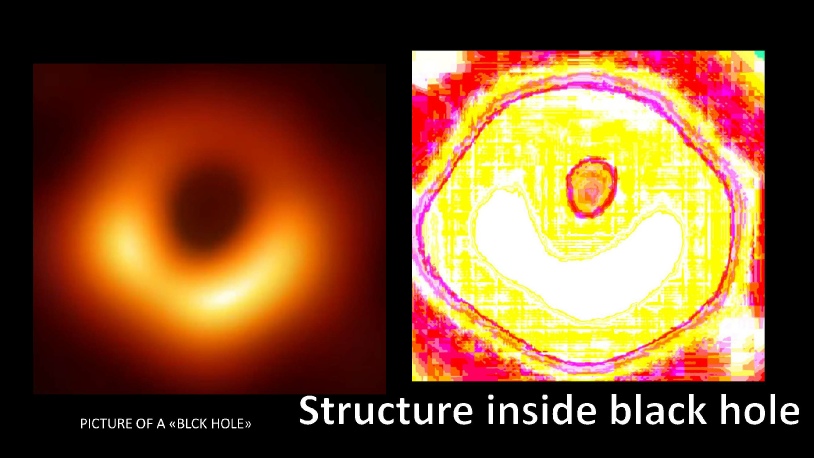
M87 lies at the heart of the Virgo cluster of galaxies. It has an active nucleus and jets are seen to be ejected from its nucleus. In 2019 a luminous ring around a black region was pictured at its heart and this picture was shown around the world as a direct image of a black-hole. Instabilities seen in this imperfect ”doughnut” (to the left) is characteristic of rings formed in many Active Galactic Nuclei centres. The black is not truly black. It contains a fractal spiral structure in its womb.
For more see here
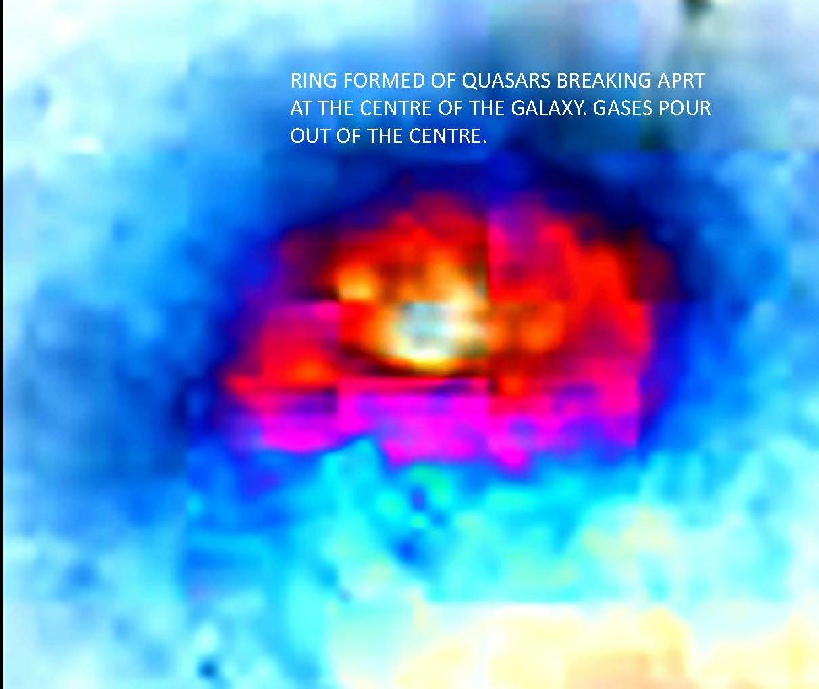
Example of the nucleus of a Seyfert galaxy which shows a luminous ”torus” embedded inside a gas and dust cloud forming a bigger ”torus”. The luminous ring which consists of several luminous blobs, is seen breaking apart : One blob is being ejected to the upper left side. These blobs will have the properties of quasars. It is evident that the outer torus, which is made of hydrogen gases, is created by ejections from the centre. At the dark spot at the centre a spiral wheel should exist as in many other galaxy centres.
For more see here
